
John Crever shares an election-year song to sing with students.
“….. I Have to Ask the Reason Why”
Music, songs in particular, have been part of our voting culture since the start of the nation, and for as long as politics have been recounted, music has always been a part of the process. Whether it be an upbeat wind band march to call potential voter’s attention to a city-center tree stump for a candidate to explain his position, to the political satire of Mark Russel and his piano cutting like a knife through the murky rhetoric of blustery candidates as they develop their positions on voter issues, to the concert performances by renowned divas and rock stars at the inauguration celebrations, music grabs people’s attention, gives us something artful we can all agree on while setting the tone for the event.
Just weeks away from one of the most contentious presidential elections in US history, amid a once-in-a-century global pandemic threatening a global economic recession, I wonder what students think about the state of the world that adults have created for them today.
I first heard this song on Amidon’s Album “A Song in My Heart,” and every autumn, as we approach election day in November, this song rises inside of me as a jaunty, age-appropriate tune that speaks to what our vote, as citizens, is about. Often, I think of my vote as my voice in the matter and my one chance to give feedback to the executive leadership of the nation.

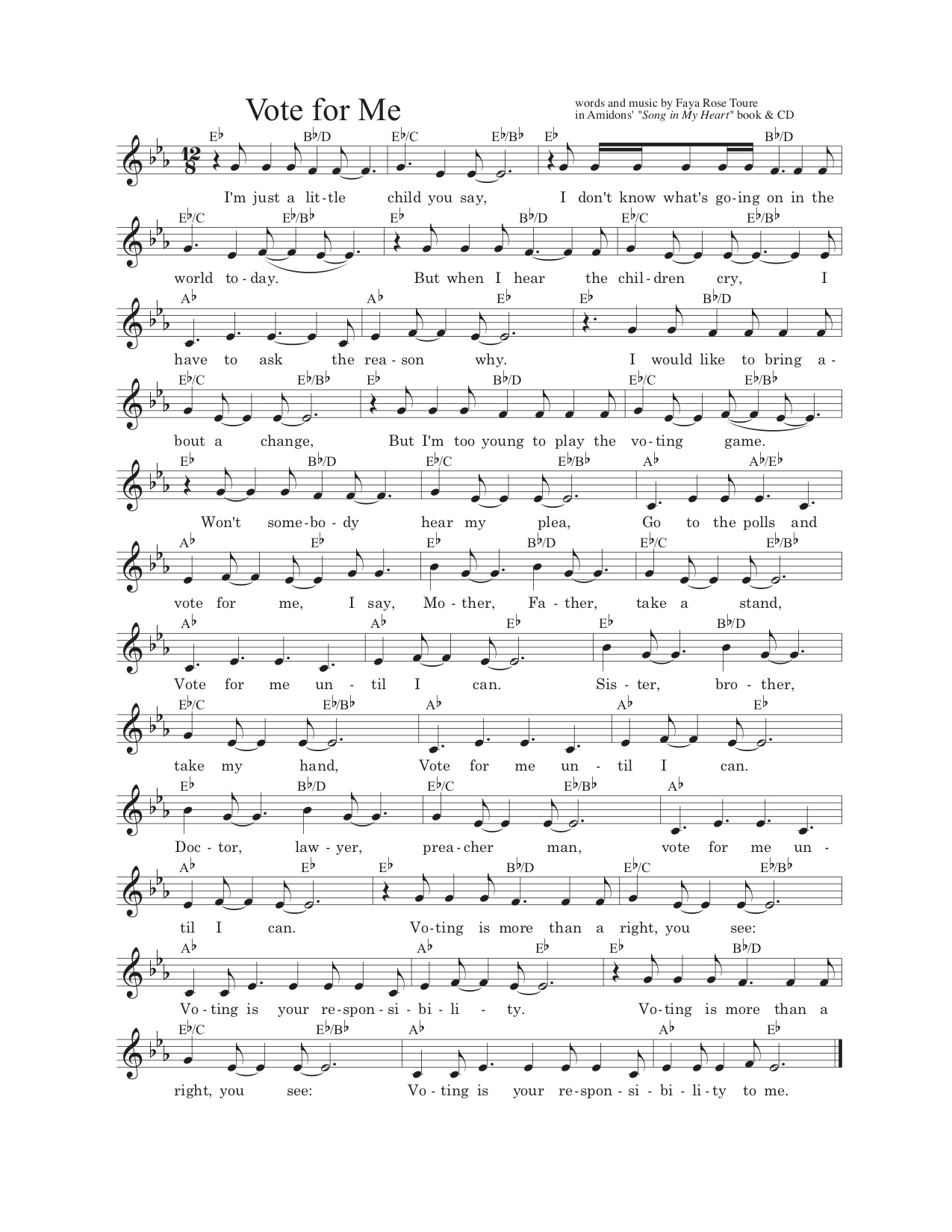
The song “Vote for Me” widened my eyes about the power of my vote as a parent, educator, and community leader. Written from a child’s perspective, the lyrics ask adults to vote with the long-term vision of our nation’s children in mind, similar to John Feierabend’s 30-year plan to grow musically rich adults. I’m excited to be using this song this election season for at-home online learning. 😉
In recent years, I’ve been looking to replace a couple of my go-to patriotic standards with songs that have more inclusive lyrics and represent the views and feelings of all Americans. “Vote for Me” is one song that fits the purpose.
I wrote Peter Amidon asking for permission to reference his family’s recording of the song. Peter writes:
“Vote For Me” is written by Faya Rose Touré* (also known as Faya Rose Sanders), an American civil rights activist, educator, lawyer, and songwriter who lives in Selma, Alabama. She was born and raised in North Carolina, and in 1969 she went to the Harvard Law School. Faya Rose Touré worked on a number of high profile civil rights cases during her law career including the case of Pigford v. Veneman, the largest civil rights case in history. She founded the National Voting Rights Museum; the Ancient Africa, Slavery and Civil War Museum; and the 21st Century Youth Leadership Movement. Faya Rose Touré was Alabama’s first African-American female judge.”
Peter goes on to write, “when Becky Graber wrote to ask permission to sing her song for a project, Faya Rose Touré replied, and I quote:
“Of course you have my permission and blessing to sing “Vote for me” for when I wrote it, I wrote it to share. I truly support what you are doing, I am so happy that you are telling the story”.” Reprinted with permission from Peter Amidon.
When Peter and Mary Alice Amidon made the recording, their sons Sam and Stefan Amidon pleaded with listeners to vote for them. The first two times I listened, while driving down the highway, I wondered, “What office are they running for?” 🤦🏻 Listen on Youtube.
Here’s a recent recording made for the Women Sing 100 Virtual Song Festival, held on September 13, 2020, to celebrate the 100th anniversary of the 19th Amendment to the Constitution. I like this version because it demonstrates Peter’s virtual choir tutorial and how we can keep our communities singing together during COVID-19.
We sing a lot in my classrooms, probably because some of my strongest musical memories of my childhood were singing in class with the teacher at the start of the day, after lunch recess, and in music class. Throughout the school year, I share singing packets of age and seasonally-appropriate songs that I teach and sing with students in each class. Over time, this becomes the school repertoire that I can call on at any time for an all-school sing, emergency coverage of a class, a PTA tea party, or whenever the mayor calls and asks for children to sing, opening up an event. It was good advice that my mentors gave me to always start the year out with one month of review of known concepts and songs from the previous year and to review and teach the patriotic songs in September so the students have a ready repertoire that can easily be shared off-site at Veterans Day commemorations in cemeteries or at the American Legion halls.
The lyrics:
“I’m just a little child, you say
I don’t know what’s going on in the world today
But when I hear the children cry
I have to ask the reason why
I would like to bring about a change
But I’m too young to play the voting game
Won’t somebody hear my plea
Go to the polls and vote for me
I say: mother, father, take a stand
Vote for me until I can
Sister, brother, take my hand
Vote for me until I can
Doctor, lawyer, preacher man,**
Vote for me until I can
Voting is more than a right you see
Voting is your responsibility
Voting is more than a right you see
Voting is your responsibility to me
I’ve worked much of my career in communities where many students had limited access to much of what we take for granted in suburban communities. One of the gray areas inequities I’ve observed is the informal mentorship that students receive simply by interacting with various adults who are achieving their long-term dreams. For many of my pupils, their teachers are the only people they regularly interact with who went to college. When I heard elementary music teacher Daniel Potter from West Windsor, NJ, put up this online lesson for his students last spring, three it got me thinking again this year about a line near the end of this lyric and the words I ask my students to sing.
What I really like about Daniel Potter’s rendition of the song is on the second half of the refrain, he replaces the lyric “Doctor, lawyer, preacher man,” with “People all across this land, calling everyone eligible to vote to the polls, not for themselves, but the future of the children of the nation.
According to the Pew Research Center, less than 63% of the eligible voting population show up to cast a ballot. When elections continue to hinge on one percent of the popular vote, this year more than ever, I have to wonder why. I know I’ll be singing this song every opportunity I get as we push into the homes of our students with online distance learning. A great day would be having entire families learn this song and post it back with Seesaw videos. 💯
*If you attended the 2018 FAME Biennial conference in Chicago, you may remember our keynote speaker Nick Page, leading a night of community singing and the memorable moment with this other well-known Faya Rose Touré song: “I’m Gonna Lift My Sister Up, She is Not Heavy”
**“Doctor, lawyer, preacher man” could be substituted with “People across this land.”
Read the blog at the Feierabend Music
John Crever is a FAME teacher trainer, musician, educator, and parent based in Portland, Oregon, where he plots his Tuneful, Beautiful, Artful expansion across the western states.


John Crever